Wednesday, October 26, 2005

Just a Field in Normandy

by Tim Perrin


“It’s just a field,” I said to myself. And that’s all it was: several dozen acres of open pasture land, home to three horses who were curious about this man with a camera who had stopped his red VW van on the side of the road to take their pictures as they grazed in their field.

Its western border was marked by a dirt road, twin tire tracks next to a row of trees and hedges. A hundred yards or so away, on the eastern side, was another, similar hedgerow. Off in the distance, about four-tenths of a mile away, I could see the fence and hedge along the northern boundary of the field. On the south side, a paved road, barely two lanes wide, led back about a mile to the tiny Normandy village of Ste.-Mère-Église.

But without even closing my eyes, I could see the P-47 fighters coming in to land, turning onto final approach half a mile to the south then skirting low over the road, a little kick of the rudder to compensate for a bit of cross-wind, then finally touching down on the temporary metal runway. Some of them would set down heavily, shot up and barely flying. Most would be okay. Some of them would not have come back at all.

One of those who came back every time he flew was a 24-year-old redhead from Gardena, California, Second Lt. Alton M. Perrin, my father and the reason I was standing by this field. “Be sure to go to Ste.-Mère-Église,” he had said to me just the week before, not knowing that it was already on my itinerary. I was going because it’s the town made famous in the movie The Longest Day as the site of a botched paratroop drop that left a soldier, played by Red Buttons, hanging from the roof of the church, his parachute snagged on a parapet. It also plays an important role in the more recent Band of Brothers TV series from Steven Spielberg and Tom Hanks. But my father told me that he had been based out of Ste.-Mère-Église in the weeks after the D-Day invasion. Suddenly what had been a casual interest took on a much greater importance.


The P-47 Thunderbolt was the unglamorous workhorse of World War II. Not as flashy as the sexy P-51 Mustang, the “Jug” was actually bigger, could carry a larger payload, and could fly faster, higher, and almost twice as far as the Mustang. When it first came into service in 1943, it flew bomber escort missions, but by D-Day, it had been converted to primarily ground support duty.

When my dad arrived at Ste.-Mère-Église, he was fresh from flight school in Texas. Experienced aircrews were always reluctant to take a new pilot into their tents. The odds were long that the rookie would not survive his first five flights. Just getting to know some nice 21-year-old from Omaha—or 24-year-old from Gardena—could leave you depressed when he failed to return the next day.


But somehow, every time he flew out of this field, this simple horse pasture in Normandy, Lt. A.M. Perrin, US Army Air Corps, managed to make it back. For six weeks, starting a few days after D-Day, this was his home. Just six weeks living in tents. He recalls that there were tents to sleep in, latrines, a mess tent, the runway, the planes—and a baseball diamond; wherever there were American troops, there had to be a baseball diamond. From here he moved on to airstrips in Belgium, the Alsace, and Germany, primarily in support of Gen. Patton's Third Army. On VE day, he was flying out of a former German airfield in Bavaria. Ninety-nine times, he strapped himself into his plane. Ninety-nine times he headed out to drop his bombs, fire his machine guns, and, in turn, to be a target for German gunners.

After the war, he hung up his leather flying jacket and, with one exception, never sat behind the controls of an airplane again. Not because he didn’t like flying. It’s been obvious to me over the years that he loved the flying part of being a pilot.

It was the killing part that he didn’t care for.

My father taught me that not all wars are the same, not all battles not just. When Vietnam came along, and especially after the killings of John Kennedy, Robert Kennedy, and Martin Luther King, he left his job on the newspaper in Riverside, California, and joined the Peace Corps. It was time to put back some of what he had been forced to take from the world. He served as deputy country director in Afghanistan for two and a half years. One of his primary tasks was fending off stateside draft boards trying to yank Peace Corps volunteers out of Afghanistan and send them off to die in Vietnam.

But it was several years later, a day I’ll always remember, that he told me how proud he was of me for resisting the draft and opposing the war in Vietnam. This was my genuine, gold-plated war-hero father speaking, and he was telling me he was proud of me for being a draft dodger.

So here we are, sixty years after the end of my father’s war, thirty years after the end of my generation’s war, and hip deep in the war we have managed to fabricate for his grandchildren’s generation.

When I was a child growing up in Riverside, we used to do air raid drills—duck and cover—as if that would help us when the “Reds” dropped the big one on nearby March Air Force Base. We were told how those dastardly Communists were forcefully exporting their ideology, stuffing it down the throats of people who didn’t want it, how they thought they knew best.

Did those men die in Normandy, did my father fly out of that pasture and risk his life 99 times, so that George Bush could turn the United States into the country that today is the one that is force-feeding the world its ideology?

I weep for my native land. As I travel around Holland and Belgium and France, I remember the men who died, and I visit the cemeteries because I want those men to know that we remember—that I remember. But I feel like I need to apologize to them for what we have done with what they bought for us with their blood.

It is just a horse pasture in Normandy, but men like my father bought it with blood and with lives and with a sacrifice I cannot begin to imagine.

And we are squandering that heritage daily.

-30-

Timothy Perrin, 56, is a California-born writer living in British Columbia, Canada. He moved there in 1974, near the end of the Vietnam War. His father, Al Perrin, 86, was a copy editor at the Los Angeles Times from 1972 to 1990. He and Tim’s mother Patty, 80, are now retired and living in Oregon. They married two weeks after Japan’s surrender and just celebrated their 60th anniversary in August. They wonder if they are leaving their two great-granddaughters a better world than the one they inherited from their own great-grandparents.

Al and Patty Perrin surrounded by their family in July 2005. Front row, great-granddaughter Charlotte, grandson-in-law Charlie, Al, Patty, granddaughter Wendy with the newest arrival, great-granddaughter Elise on her lap. Back row, son Tim, daughter Nancy, granddaughter Terese, grandson Brian, daughter Carrie, son-in-law Norm, daughter-in-law Terre, grandson Tom.

----

Photo of P-47 from Airforce Image Gallery and can be found at Planes of World War II page.

Saturday, October 22, 2005

I Hate the Louvre

by Timothy Perrin

Saturday, October 22, 2005

Fall arrived in Paris a week ago. Months of sunny weather gave way to cloud, rain, and wind. Our umbrellas have come out of their hiding places in the van, and we have dug out our raincoats. That said, as former Vancouverites, this is hardly anything we’re not used to. In fact, we both sort of prefer things a bit cooler, so we’re quite happy with the change. When we first arrived in Holland back in August we had a couple of weeks of cool, cloudy weather and everyone kept apologizing to us for it, but we kept telling them it was okay. It still is.

On Thursday, October 20, Terre spent the day with our hostess, Danielle Lavollée and Danielle’s class. I hit the train and headed for the Louvre. In 2000, we had only 45 minutes at the end of a day at Versailles to try to “power walk” the Louvre, and Terre had seen it in 2003 with her mom and didn’t particularly want to go back. I decided to take advantage of things and go on my own.

But a most curious thing happened to me as I wandered around the halls of what was once the winter palace of the Bourbon kings of France.

I got mad. In fact, I got enraged. I finally had to leave.

Earlier on this trip, I read Jared Diamond’s Guns, Germs and Steel. He talked about governments as “kleptocracies,” governments by those who steal from the rest of us to make themselves rich. And at the Louvre, I was surrounded by the evidence of that. Here in these cavernous hallways suitable for playing games of indoor lacrosse, jai-lai, or stadium football, hung the work of hired lackey “artists” who gave their masters what they wanted, usually something to show to the world just how pious and holy they were, as if by hanging a big enough painting on the wall showing them praying, they could fool God and slip into heaven.

These are the same people who kept Europe in a constant state of warfare for centuries, usually fighting over who would get to own which patch of land and the slaves--they called them "serfs" but they were slaves--that went with it. They “foraged” in the countryside for their supplies (a polite way of saying they stole everything they needed from the peasants. The ones they didn’t slaughter outright starved). Oppression does not begin to describe the world of life in feudal Europe.

When the French people finally decided they’d had enough, bless them, and threw the bastards out, the rest of the monarchs of Europe, afraid the revolution would give their own slaves bad ideas, attacked France to try to destroy the revolution. And it took less than fifteen years before the French found themselves with a new Emperor, Napolean, who went from being the savior of the revolution to the would-be conqueror of Europe. By 1814, Napolean was defeated and the Bourbons were back on the throne, the revolution in the trash.

France is now working on its fifth republic. No country has worked harder at democracy, it seems to me. They keep coming back to it, determined to get it right.

But, as I walked through the Louvre, I didn’t see great art. I saw evidence of great corruption. I saw the kleptocrats in action. It made me long for the work of a few good old-fashioned starving artists like Van Gogh who never sold a single painting in his lifetime. He painted because he had to paint. He made art because that is what came out of him.

I can’t say I hate all medieval art. I love the Girl with a Pearl Earring and much of the work by other Flemish masters. In fact, much of the work that is not built around overly pious religious themes can move me. And even well-done religious works can get to me. I can hardly look at Michaelangelo’s Pieta in St. Peter’s Basilica without crying, touched not by the religious theme but by a mother's grief. Likewise, Michaelangelo's David is magnificent and seems to capture David just at the moment when he is saying to himself, "Wow, this guy really is big."

It was just the evidence of so much wealth concentrated in one place in the hands of one family that made me want to puke.

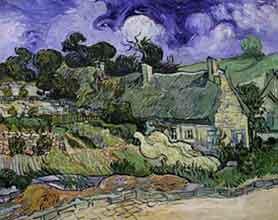
The following day, we went to the Musee d’Orsay together: 19th and early 20th century. There I stood in front of this Van Gogh with tears in my eyes. I marveled at several Monets. Yesterday, we went to Picasso’s house, and I laughed and laughed and laughed; Pablo had such a great way of looking at the world. To him, the world was a big joke, and he shared that joke with all of us.

On a tour of Notre Dame on the weekend, our tour guide—a lovely woman of about 80—argued that Louis XVI didn’t deserve to lose his head, that he was trying to bring in reforms.

No he wasn’t. He was trying to change things just enough to shut people up.

I don’t believe in capital punishment—ever. But I sure understand the anger of the French people in 1794. Louis deserved to be thrown out. He deserved to lose everything. He and Marie Antoinette needed to learn what it was like to have no bread and be told to “eat cake.”

I hate the damn Louvre and I will never return. It makes me sick. The place is an abomination. The art is largely the work of sycophants and phonies.

We can do better. France can do better. Tear the damn thing down. Better yet, break it up into low cost housing units. Do the same with Versailles. I love the thought of some welfare mom from Algeria raising her kids in Marie Antoinette’s bedroom. That will make the Austrian bitch squirm, even down there in hell.

-30-

Friday, October 07, 2005

Week 9 - Winding up Belgium


Sunday, September 25, 2005

As you may recall from last week’s installment, we left Jan, caregiver to the cat athlete, in Oudename and headed for the Brussels area.

On the way, we had to stop for a bike race, the first one I’ve seen since my teens. I heard later it was the Tour de Belgium, but I’ve no idea if my leg was being pulled or not.

Our next host was Luc Hellinckx in Halle, Belgium. Halle is still in the Dutch-speaking part of the country. (We always seemed to be about six kilometers from the language border.

Luc is a math teacher at a local technical school. His wife, Hilde, is not home. She runs some schools for Afghan refugee children in Pakistan. They only get to see each other four times a year, which is a shame given that he is a great guy.

Luc took us out for dinner at a local restaurant. He likes to cook about as much as we do.

Terre's favorite part was the cherry-flavored beer.

Monday, September 26, 2005

We stayed home, rested and caught up on e-mail. A thrilling day.

Tuesday, September 27, 2005

We took the train into Brussels where Terre took the mandatory picture of the little pissing boy. I, on the other hand, fell down and tore my knee open—again. This is the third time I have skinned my left knee on this trip. This time I also tore my jeans. I now have a small, Canadian flag patching it.

On the way home, Terre had to use her French skills to check whether the train we were getting on stopped in Halle. I had tried in English and failed miserablhy. We needed to check because (a) we weren't sure which train we were getting on (b) if we were on the right platform (it was very crowded) and (c) if this one might be an express that skipped our stop. We'd had to rush to catch it—we only had four minutes—and we weren’t sure.

Once on board, we had to carefully watch for the station since we didn't know the order they were in.

Dinner was out choice of frozen entrees. Luc started to apologize but I told him he cooked like we did.

Actually they were much better than the ones we usually have.

Wednesday, September 28, 2005

To Waterloo in the rain. This was a BIG disappointment. It’s a big pile of dirt with a statue of the lion on top. They want a €8.50 to let you climb up the big pile of dirt to the lion. We passed.

There’s really nothing to see unless you want to take a tour and pay even more money. Cornfields. That’s about it. Historic cornfields, I’ll admit, but still just cornfields.

Terre cooked us a gourmet meal that night of her exquisite corn beef and cabbage soup, something new to Luc. She laid such a beautiful table that both Luc and I got out the cameras.

After dinner, I played badminton with Luc and one of his friends for their regular Wednesday night game. I lost. A lot. Badly. There will not be pictures of this humiliation.

Thursday, September 28, 2005

We stayed another day with Luc. We are really enjoying his company and, apparently, he is enjoying ours.

Terre made lunch, this time. Egg salad sandwiches and more of her corn beef and cabbage soup. We took more pictures.

Friday, September 29, 2005

Finally, we were going to have to move on. We hung around Luc’s as long as we could. Neither of us wanted to leave! He didn’t want us to go. But our next hosts were expecting us. Nonetheless, we didn’t go until after 4:00.

Our new hosts were Jo Verwimp and Cecile Sillis, an older couple – probably my age – who have been deeply involved in the Green Party forever, like since it was yellow. Their son, Johnathan, is a law student in Brussels.

They had a great wireless Internet connection. To us, this is important. On a scale of 1-10, it gives a host 12 points. I think Jonathan set it up.

They have been very involved in SERVAS as well for many years. Unfortunately, we didn’t get to really start to get to know them until breakfast of our last morning when the conversation become animated and interesting. But then they had to rush off to a Green Party meeting and we had to move on.

Saturday, September 30, 2005

We visited the Atomium, a building designed to look like an atom. It was put up for the 1958 world’s fair in Brussels. We couldn’t go in, however, as they were working on it.

Saturday, October 1, 2005

We had several more invitations in Belgium, but we decided to move on to France—finally—since it was now October. We headed south towards Amiens and its marvelous cathedral. We camped for the night in a village campground, about 25 kilometres north of Amiens.