Thursday, June 01, 2006

More Pictures of Gracie

Since some of you have been foolish enough to ask, here are some more photos of our new pride and joy, Gracie Perrin.


She's very helpful around the garden. Here she' s helping me plant a new French lilac bush which blooms more than once a year.


She's convinced she's a lap dog, which is fine now but may present a problem when she hits 65 or 70 lbs. Here she is with Terre's mom, Sharon.


She has, of course, taken command of the beds.


And she also has, of course, completely hoodwinked me into giving her whatever she wants.

Today, we managed to go on our first real "walk," over by the golf course. She had to conquer her fear of stairs and take a flight of fifteen or so concrete stairs, which she managed. She chased one of her toys a bit but she has a very short attention span, trying to take everything in at once. It was nice to be able to go for a real walk instead of only for a house or two down the street.

Take care.

Tim

Wednesday, May 31, 2006

Gracie

One of the things that we were looking forward to coming home for was getting a new dog. We even had her picked out and placed a deposit on her while we were still in France in March. But because of some scheduling conflicts, she didn't arrive from California until Thursday, May 25.

She was worth the wait.

Meet Gracie, 25 lbs of pure chocolate labrador retriever. She's three months old and a real cuddler.


Here, she's a bit reluctant to come out of her shipping crate. Just who are these people?


Her reticence did not last long however. Here she is about three hours later trying to figure out which remote controls the cats.


And we have also discovered she is quite the collector. Visible in her crate are one of Terre's white shoes, two pink water boots, her brush, a green and red pull toy, Josh's old school district ID tag (he was an official therapy dog) and a bunch of pooper pick-up bags (the white things) and their box (the yellow fragments).


But isn't she the picture of innocence.


My God! What have we done? We've never been happier, that's what.

Tim


Wednesday, January 18, 2006

No Bull


Remember the big bull? I promised I'd tell you what he was about. I've been informed by several sources that he is the logo for Osborne Sherry. Sherry comes from the area around Jerez al Frontera and the word "sherry" is a mispronunciation of the word "jerez." It's an English mispronunciation because it was English folk who came to the area and make the sherry industry happen. That's why it's Osborne Sherry and not Lopez Sherry. There are lots of English names in that part of the country.

So, now you're ready to go on "Who Wants to Win a Million Dollars?"

The Writer, the Hieress, the Teacher, and her Lover

by Timothy Perrin

Each afternoon at five, Terre is having una aventura sentimental, a love affair, with Salvador, her hunky, long-haired Spanish lover. Salvador’s other lover is the muy bonita Isabel, mistress of the house where Salvador is chauffeur. Isabel only recently married Andre then brought Salvador along on the honeymoon where Andre abandoned him at sea in an inflatable boat. Then there is Walter, the bald butler, and una tia loca, a crazy aunt. Walter has a secret; the aunt has an imbalance in her brain chemistry.

These are the characters on the trashy Spanish soap opera El Cupero del Deseo, The Body of Desire. Every afternoon at 5:00, we sit down for our daily Spanish lesson, 60 minutes of passion, drama, bad makup, and overacting—a lot of overacting. But the story is simple, the dialog well enunciated—usually—and the subtitles clear. And if Salvador and Isabel are easy on the eyes, well, that’s just a bonus.

The show is fun everyday. We always get a good laugh or two, particularly from the music. Whoever does the music seems to have discovered the “Whomp! Whomp! Whomp!” key on their new electronic keyboard, and that is all they know how to use. A favorite shot on the show is a closeup of someone’s face as they get “the news” as the music goes “Whomp! Whomp! Whomp!” This being a soap opera, the same news is often good for several “Whomp! Whomp! Whomp!” sequences. First, one woman picks up the telephone. ¿Qué? ¡No! What? No! “Whomp! Whomp! Whomp!” Then, ten minutes later, someone else gets a phone call. ¿Qué? ¡No! “Whomp! Whomp! Whomp!” Eventually, maybe tomorrow, maybe next week, we’ll get to hear the upsetting news. “Whomp! Whomp! Whomp!”

Another quirk of the show is that the character played by the top-billed actor has been dead for some time. He has not appeared in a single episode that we’ve watched in our four weeks here. In fact, we just caught the opening credits for the first time last Friday and wondered who the heck he was. He doesn’t even have to show up to be a corpse from time to time. Now that is an easy gig. I wonder how much they have to pay him. I want his agent.

But our favorites are Walter and the aunt, partners in crime, and, because their parts are so cheesy, they actually feature two of the better actors on the show because they have to walk the line between farce and drama. With too much eye makeup, both of them have to do several close-up big-eye scenes in each episode, scenes sure to be reprised in tomrrow’s flashbacks and already previewed yesterday.

Walter, it seems, is on the run from his past, and to prove it, he has kept the newspaper clippings, complete with his “this man wanted by police” picture. Why? Don’t ask me. I’m only a former criminal lawyer. Then again, my experience with criminals tells me he’s not that unusual. They’re not the brightest bulbs in the marquee.

And the aunt. Well, what can you say about a woman who’s got her hands in everything—and I mean everything. She is the ultimate fifth business, the character whose job it is simply to keep the kettle boiling, and she’s one hell of a heat source.

And all this is actually in service of a good cause: our ability to speak Spanish. It really helps. No. Really. Aw. Come on. I mean it. Now don’t give me that look. It does help. It does.

Hasta mañana.

(See?)

Tuesday, December 27, 2005

Pictures of Our New Home

by Tim

We have landed in a tiny town in Andalucia called Carboneras. It is on the lower right corner of the country, about an hour's drive east of Almeria and two or three hours south of Alicante. We'll be here until the end of January.

From here, we can make day trips to Granada, Cartegena, Almeria, Malaga, and other places of interest including Mini Hollywood where Sergio Leone filmed him Spagetti Westerns: The Good, the Bad, and the Ugly et al.

Here are some shots of our new digs taken by Terre with her Christmas present, a new Canon digital camera that she can drop in her pocket. She loves to take pictures.


Above and below are two of the views from our deck.


The view out our bedroom window.


The closer selling point on the apartment was this little girl and her buddy, a great big black and white guy, our first visitors.


This is the street looking up from the sea.


The kitchen area.


We do not plan to be trying out the bike on this particular road anytime soon. We came across it on our way into town.


Another view of our approach to Carboneras.

We hope everyone has had a great Christmas and Santa has been good to you all. We miss everyone... but not enough to come home yet.

Tim

Barcelona Calling

Text by Tim; photos by Terre

I can sum up Barcelona simply: it is my favorite city in Europe. So far.

I like it better than Paris. I like it better than Rome. I like it better than, dare I say it, Dublin.

This is my second visit. We stayed two nights in 2000, just enough time to get a taste of this beautiful town. Now, on this trip, Terre and I would get up and say, “Want to stay another day?” Sure! So we did. Five times. Every time we started to move, we changed our mind. Our cheapie little Formule 1 hotel was about 800 metres from the train station. It was 5 € return for the two of us into town. What more could you want?

So, we walked and walked and walked around Barcelona.

The first day, we took the train to Sants station. I chose it because, on my transit map, all of the train lines went there, so I figured it must be central. And there was a big street heading northeast from there that just had to be Las Ramblas, the city’s hip, happening street. So, we popped up from underground, found the street and walked as far as Diagonal. Nope. This definitely was not Las Ramblas. A nice street, but no tourist junk. No flower stands. No one selling birds. Nope.


So, I got out the map. Ah, this one must be it. We walked another mile or so down Diagonal to another street and walked the other way down it. Again, I was mistaken. So, we gave into the winds and just wandered.


Getting on towards sunset, we ended up in the university district watching some skateboarders try to break their necks. We were both tired and ready to pack it in when we saw a sign: “La Rambla.” Well, signs I can follow. Five minutes later, we were on one of Europe’s most famous streets—even if it had taken us four-and-a-half hours to get there. Instead of packing it in, we stayed up another couple of hours.

A “rambla” is not a ramble, it is a dry stream bed and this street was built over one. Today it is called Las Ramblas—the plural—because various sections of the street have distinct personalities.

First let me describe it a bit. At one point in its history, this was a very wide avenue, probably six or eight lanes plus parking on either side. But a long time ago—judging by the age of some of the trees—the city decided it really was a place to ramble. So they turned it into a pedestrian area. There is a one lane service road on either side, no parking, and the middle is a raised, concrete island. It runs more than a kilometre from Place Catalunya (Plaza Catalonia) to the Cristopher Columbus monument down at the waterfront, the one where Columbus is pointing to the east, away from the New World. (He gets a monument in Barcelona because this is where he made his “official” landing and was met by Fred and Izzie.)


There is one section where they sell birds. How any town can support the sale of so many parrots, finches, canaries, and budgies is beyond me. I mean, are they really that popular? And most of these stalls also sell cute little bunnies. However, I suspect that these creatures are not destined to be family pets but for family pots.

We ended our five days in town by going to see King Kong, this time in English with Spanish sub-titles, but surely it wouldn’t have mattered if it had been in Swahili. Lots of fun.

We are heading south for the sun!

More Basque Country

text by Tim; photos by Terre

We left the Basque Country on Sunday morning, December 11, after a week there: three days in Bilbao, three in Vittoria-Gasteiz, and two in Luyando.

Bilbao was basically a washout—literally. It rained—hard—practically the entire time we were there. We were cooped up in our hotel room almost all the time. We finally ventured downtown as we were leaving the city. We caught a glimpse of the Gugenheim art museum. Well, more than a glimpse as we parked across the river and ate our lunch. It is quite a striking building, a work of art on its own. But then we hit the road for Vittoria-Gasteiz.

On the way there we had to cross a 700 metre pass where it was threatening to snow. Our rather worn front tires made us nervous. The back ones were fairly new, but the front ones were definitely ready for replacement. We moved that way up our priority list and despite two intervening national holidays where everything was closed, we managed to get new tires before we left Vittoria-Gasteiz. Of course, we’ve not seen any snow, but we are ready!

Vittoria itself was a delightful surprise. It is a charming city, the provincial capital. It lies in a valley at about 500 metres elevation. Our host, José Luiz, works for a shipping company. He had a few days off as Tuesday, Dec 6, was Constitution Day, and Thursday, Dec 8, was the feast of the Immaculate Conception, both holidays. Like many Spaniards, he was also taking off the day in between - a bridge day - so he had lots of time to spend with us. If a person takes the rest of the days of the week off, it's called a viaduct.

Every evening, on the car-free mall area downtown, hundreds of people are out walking with their families, even on weeknights. The stores may be closed, but the place is jumpin’!The restaurants were crowded. A trio of two hot accordions and a base were just jammin’ it up. And everywhere people were in a holiday mood.

The local wine producers were putting on a wine tasting for the residents of the area and had put up large tents around the mall for folks to come to sample the vintages. We saw many people with their wine glasses in felt bags strung around their necks. This used to be potato-growing country, apparently, but Jose Luiz says that EU bureaucrats in Brussels decided there were other areas better suited to growing spuds and this area has converted largely to other crops, including a now thriving wine business.

On Friday, December 9, after we got our tires, we moved to Amaia’s place in Luyanda, a village in a mountain valley. She is a woman about Terre’s age who works in accounting. Amaia has lived her entire life in this village. She and three of her four siblings were born in a house just a few blocks from where she now lives.

But where she now lives is a sign of what is happening to her little village. She lives in one of eight twelve-unit apartment blocks put up at the edge of town. And there are others throughout the valley. The commuter trains to Bilbao make it a 20-minute trip to downtown and with house and apartment prices in the city outrageous—we’re talking half-a-million euros for a 120 sq. m. apartment (1300 sq. ft., $600,000 US)—folks are looking to places like Luyando if they hope to ever own their own homes. Amaia’s rural valley is quickly becoming a suburb.

On Saturday, she took us to see “el nacio del Nervión,” the birth of the Nervión river. This is a spectacular waterfall that plunges 600 metres, almost 2000 feet, from a hanging valley. Most of the year, she told us, it is dry. We were lucky and caught it on a wet day. It was truly breathtaking. I don’t think our photos can begin to capture it.

On Sunday, we were supposed to head west to Gallicia, the upper left-hand corner of Spain, but one of the neat things about this trip is we can do what we want, and we found we didn’t really want to go that way. So we turned the other way and pointed Yoda east, for Barcelona. It was a long day, almost 600 km., but the change in the landscape was quite marked. We went from damp, dark forested mountains, something like the coast of northern California, to land that looked more like what I had expected of Spain—dry, semi-arid, scrub.

And on some of the ridgelines are these massive black silhouettes of bulls. Now what is that about? Darned if I know, but they seem to be all over the country. I’ll let you know what they’re about when I find out.

One last thing. Before we left Vittoria-Gasteiz, we had decided to enjoy one of Europe’s truly cross-cultural experiences, something you can only do over here: go to a dubbed American movie! We chose Jodie Foster’s latest, Desparecido! (Disappeared assuming the name is the same in English) about a woman whose little girl goes missing on a trans-Atlantic flight. We figured “How difficult can it be to translate this one?”

We were right. The movie was so predictable that you could have watched it in any language. Woman’s husband dies in Berlin. She and daughter flying back to America with the body. Child goes missing; how and why is never explained. We checked that with some Spaniards, by the way, at the end. They didn’t know either. Anyway, nobody can find her. “How can a seven-year-old girl just disappear on an airplane?” She freaks. Nice looking guy in the row behind her turns out to be air marshall, who, in my opinion, should have handcuffed her long before he did. Anyway, she manages to cause havoc all over the plane. She shorts out a bunch of circuits, could have easily crashed the damn thing, and she’s still not cuffed to her seat! They tell her that her daughter is not on the manifest. “Your daughter was killed with your husband.” “No! She came on board with me.” But no one has seen the little girl. The woman is obviously crazy. Yada, yada, yada.

Could you have written this in your sleep? Could the seven-year-old girl in the script have written it in her sleep? No translator needed.

We had a blast!

Maybe we’ll get our courage up to go to a purely Spanish movie in Spanish soon. But not yet. In Belgium, we watched a movie in Italian and English with Dutch subtitles. Luc was translating for us the parts that weren’t in English, and I got pieces of the Italian. But it was exhausting for all of us. So, no pure Spanish for now.

By the way, the quality of the dubbing was incredibly good. Generally, you could not tell. The dubbing actors and the translators had worked hard to match the new dialogue to the old so that the consonants—which are the sounds we make with our lips and that you can see—remained the same or similar. If you can pretty much match the consonants, it won’t look dubbed. Ninety-five percent of the time, this did not.

Next stop: Barcelona.

Monday, December 05, 2005

That Old Bilbao Moon

by Tim Perrin
Photos by Terre Perrin

That old Bilbao moon,
I won’t forget it soon.

That old Bilbao moon,

Just like a big balloon.

Andy Williams used to croon that tune from one of my mother’s LPs when I was a kid. I didn’t know where Bilbao was at the time, much less imagine that I would ever be there. But, tonight I am in Bilbao, Spain.

It’s not at all what I imagined—when I imagined it at all.

From Andy’s song, I saw a quaint little town on the Bay of Biscay: romantic, small. Instead, I was greeted with a sprawling city of 350,000, one criss-crossed by freeways. Our hotel is near one of the biggest Ikea outlets I’ve ever seen which is attached to a shopping centre the size of lower Manhattan that is across the freeway from another mall the size of south Jersey. And it’s Christmas shopping time. Gee, is the traffic fun or what?

Now, perhaps there is a small, romantic, quaint core to Bilbao. We’ll try to find it if there is. I expect there will be. This is an old city.

But what is most noteworthy tonight is our trip here.

Today is Saturday. We left Bordeaux in heavy fog on Wednesday, intending to drive to Spain in one day. But, by the time we had driven from Bordeaux to the coast—about 60 km—it had turned beautifully sunny, so we took the scenic route through little seaside village, some of which go back to pre-Roman times.

There has been a definite shift in the architecture. We are seeing more sprawling houses and more tile roofs.

We eventually arrived in Bayonne after dark. Now, by the most direct route, this is a two-hour drive. By the Tim and Terre route, it took six hours—including a stop for perhaps the worst Tex-Mex food in my life. We ordered nachos. We wondered what wonderful exotic French cheese they were going to use on the chips. Would it be emmenthal? Something with peppers or olives in it? A goat cheese? What we got was a pitiful pile of “zesty” flavoured chips with a dribble of orange processed-cheese stuff that may have once been heated. It was disgusting.

But the weather had certainly turned; it was amazingly warm, at least into the low- to mid-teens, which for what we’ve been used to, is warm. There was a breeze blowing. It was a nice evening.

We both woke up on Friday hoping to take a ride on the lovely bike trails we had spotted around Bayonne the night before. We were to be disappointed. It was pissing down rain and hail—big hail. Overnight, it had started blowing so we should have known it was coming. In fact, I had commented that it sounded like a frontal passage. We walked over to the nearby Intermarché to do a bit of shopping and just missed getting caught in a deluge of rain and hail.

We went to Carrefour—a big superstore—and did a little bit of shopping and then headed down to see the beach at Biarritz. When we got there, the surf was magnificent. The same storm that had blown the night before was creative huge waves that were smashing against the rocky shore and throwing up huge clouds of spray.

We had, of course, left the camera behind—again! So, we went back to Carrefour and I bought Terre her Christmas present, a Canon 750 pocket camera. But it was too late to go back to the beach for any decent pictures.

Which brings us to today. We got a decently early start—for us, that is any time before noon. We went back to the beach and got some passable shots of crashing surf, but nothing like yesterday when the surf was higher, the sky was darker, the light more oblique, children obeyed their parents, policemen never took bribes, and Canada Post delivered a letter across the country in two days.

So we started lolligagging down the coast. By the fastest route, Bayonne to Bilbao is 1:34. We took all day, but what a day!

A few miles before the French border, we stopped at one 19th century mansion on a bluff overlooking the coast. It had been the home of Antoine d’Abbadie, described as a “explorer, geographer, linguist, and astronomer” by the French Academy of Sciences of which he was a member and to whom he left his little shack above the sea. He had built an observatory and invited astronomers to map all the stars in the heavens. The house is decorated with sculptures of crocodiles, boa constrictors, monkeys, and elephants. And he wasn’t afraid of a little dirt under the nails himself; he personally drew the first reliable maps of Ethiopia.

Ten kilometres later, our poor little van was struggling up a twisty road from Hendaye at the mouth of the Rio Bidasoa. The bay there marks the border, both geographic and political, between France and Spain. To the east, it is relatively flat. To the west, it is up, up, and up. We drove all the way to the top in second gear, rarely topping 30 km/h. But once up there, it was truly spectacular. My God, what scenery! At one point, we were driving along the ridge of a mountain crest. On our right, the land tumbled half a kilometre down to the crashing Atlantic. On our left, it fell precipitously into a river valley almost as deep. Across the valley, the 1400 metre peaks of the Sierra de Aralar were sporting winter’s first snows.

When we finally came down from the ridge, we passed through little towns situated on tiny bays with tiny harbors, tiny beaches, tiny streets, and names like Zarautz, Getaria, Zumaia, Deba and Lekeitio.

Every time I look at a sign, I feel like I am in Turkey. The Basque language is not even in the Indo-European family of languages and has nothing in common with Spanish or English. The Basque are one of the oldest peoples in Europe, possibly the oldest, probably direct descendants of the Cro-Magnon people who first lived in the Pyrenees 40,000 years ago. They were here before the Celts, before the Phonecians and Cartheginians, before the Romans, the Visigoths, and the Moors. Many of them still live in stone houses—called caseríos by the Spanish—that were built by the forbears. Their ancient legal system or fueros were suppressed under Franco, but they have had their own regional parliament since 1975. Nevertheless, there is still a strong movement for independence for Euskadi, the Basque region of Spain.

The countryside reminds me of the northern California coast: rugged, and gorgeous, a total surprise. We have been four months in flatland: Holland, Belgium and western France. A “mountain” there hardly qualifies as a “rise” in BC. But here, we are definitely back into the hill country, the land that Terre and I both love, and even better it is right by the sea.

After our few days in Bilbao, we start into another stretch with SERVAS hosts. We will be two days 35 km south of here in Vitoria-Gastiez, then two days in a tiny village of 750 people. Then we expect to spend next Saturday night on the road before arriving at A Coruña on the northwest tip of Spain for a few nights. We will be spending Sunday and Monday with a nice couple with whom I have been corresponding in Spanish. In fact, I’ve been doing virtually all my SERVAS correspondence in Spanish—painfully slow and with much reference to both my dictionary and grammar book, but it is helping me get back into the language. And then we are meeting my clone. He is a young man in his 20s who, when I started to read his list of interests in the SERVAS directory, I would have sworn I was reading my own: computers, electronics, listening to shortwave radio, biking. But the kicker, the one Terre refused to believe, was that this young man plays the harmonica. Oh, it’s gonna be a hot time in Gallicia next Tuesday night!

Spanish Lessons

by Tim Perrin

Something wonderful happened today. I said, “Después.”

Después is Spanish for “later.” The maid had knocked on the door of our hotel room. We weren’t ready to go, and I said, “Después.” Come back later. No big deal, you say.

What makes it wonderful is that I did it without thinking, without going through a mental lookup table to find the right word. I just said it. I knew I wanted her to come back and the word that came out of my mouth was “después.”

Now, when I was sixteen and had been actively studying Spanish for seven years, I had reached the point where I was modestly fluent and would occasionally catch myself thinking in Spanish. Of course, as soon as I caught myself doing it, I stopped. But it was a neat sensation. And here I was, 40 years later, doing it again, if only for a moment.

Of course, I was still in France. We were in Bayonne, about 20 miles from the Spanish border, but my poor brain has been trying to speak Spanish form the moment we landed in France, two months ago. I can’t tell you how many times I’ve said “sí” instead of “oui” or how often I’ve been able to quickly come up with the Spanish word for something only to have to struggle to find the French word. My formal study of French consists of two semesters in a university extension conversational French class in my 20s. Spanish I started when I was nine and did every year but one until I was sixteen, including summer schools. It was often a repeat of Spanish One, but I got the basics drilled into me pretty good. And, living in southern California, I had Hispanic friends and Hispanic culture all around me. Spanish was a natural. And, besides, from the beginning, I have loved the language (and the food). It is melodious and beautiful. None of the other languages I’ve studied is more pleasing to the ear. Italian—as much as I love it—tends to be a bit singsong. French sounds like you have marbles in your mouth and half the letters could be thrown away. Latin forever makes me think I am an altar boy again; I can almost smell the incense. And Russian is fun, but it is all guttaral and full of coughing sounds.

Since my move to Canada 31 years ago, my opportunities to use my Spanish have been limited to the occasional vacation in Mexico. So to say it has become rusty is like saying the Pacific is a bit of a pond. Even then, I’m always amazed at how quickly it comes back south of the border.

Tonight, when we got to our hotel, traffic was jammed right up and I had to take the car around the block while Terre got out to go get us a room. But by the time I got there, she was nowhere to be seen. I walked into the Formule 1 Lobby and slipped into a conversation with the young man as easily as if I knew what I was doing. I wasn’t translating. I was just listening and speaking. Man, I love it when it works like that. I didn’t get every word, but I don’t need to. I got enough to know what is going on and I was able to say enough to put through what I wanted to say.

The Formule 1, as it turned out, was full for tonight (Saturday, December 3) so she had left.

“¿A donde va?” Where did she go?

“No sé.” I don’t know, he shrugged. “Salida.” She left.

By the way, I finally found Terre at the Ibis Hotel next door where she’d found us a room. “Did you have any trouble with the Spanish?” I asked her.

“None at all,” she said. “The woman at the desk spoke English.”

We had a good chuckle. Then we walked back to the Formule 1 to make a reservation for the next two nights. Terre walked in and started to speak to the young man in English. He replied in impeccable English. Often, in Europe, when they detect an accent and a bit of a struggle with their language, they’ll kick over to English. The fact that this young man had spoken to me in Spanish was the greatest compliment he could have paid me.

I know I know very little Spanish, really. But if you believe in the 80/20 rule—you need to know 20 percent of Spanish to do 80 percent of the communication—then I think I’m way past 20 percent.

It’s our first night in Spain. I may—will—get my comeuppance soon. But, tonight, I am enjoying the feeling of being somewhat competent in another language.

Adios. Hasta luego.

Tim

P.S. I got my comeuppance within 24 hours (of course) when I tried to ask the cashier in the box office at the theatre how much a ticket was. A young woman standing next to me had to restate what I said, but pronounce it properly so the poor cashier in the box office could understand me. I had the right words, but I butchered them so badly I was incomprehensible after several tries.

And I’ve always prided myself on my accent. To quote some of my long neglected Latin: sic transit gloria mundi.

Ouch!

Tuesday, November 15, 2005

We're Fine!

by Tim Perrin

We've had very limited Internet access the last ten days or so, but I wanted to assure everyone that:

(a) we did not cause the Paris riots, and

(b) they never came near us.

We are now back in Holland to take delivery on our new bike! Then we are heading the hell south! It is cold and it is wet here. We want something a bit warmer and a bit drier. Not hot, mind you, but hovering just above freezing is not our favorite temperature.

Tim

Thursday, November 10, 2005

Where Are You, John? We Need You.


John Lennon died 25 years ago on December 8th, but I spent the afternoon with him last week in Paris.
The Cité de la Musique in the capital’s 19th arrondisment has an exhibition until June 25 called “John Lennon: Unfinished Music.” It chronicles Lennon’s extraordinary life from his childhood through to his death with artifacts, photos, films, and music—lots of great music.

Guitars are okay as a hobby, John,
but you’ll never make a living at it.”

- John Lennon’s aunt

Lennon was abandoned by his parents. His father, a merchant seaman, just took off to sea during World War II. His mother gave him to his aunt and uncle to raise when he was six. Although he reestablished a relationship with her in his late teens, she was killed by a drunken driver a few years later.

As with everything else in his life, this shows up in his music.

Mother, you had me, but I never had you.
I wanted you, but you didn’t want me.
So I got to tell you
Goodbye, goodbye.

Mama, don’t go.
Daddy, come home.

“Mother”
Album: Plastic Ono Band (1970)

In school, he was a goof-off. His report cards have teacher comments like: “A good start rather spoilt by inattention and childish behaviour,” and “Childish and a chatterbox.” His headmaster said of John when he was 12, “When he can learn to control himself, he will make good progress all around. At the moment, he concentrates on the things he enjoys doing.” Thankfully, Lennon continued to concentrate on what he liked to do rather than knuckle under to conformity.

His years with the Beatles are recounted in classic clips of their appearances on the Ed Sullivan show, their last concert at Candlestick Park in San Francisco, scenes from A Hard Day’s Night, Help, Magical Mystery Tour, and the animated Yellow Submarine. His costume from the classic cover shot on Sgt. Pepper’s is on display along with other clothing. And here you will find the guitars he used in his years with the Quarrymen, the Silver Beatles and the Beatles.

In a separate section on another floor, however, we run into the real John Lennon, the John Lennon who wanted to change the world for the better. These are the years of his solo career, the Yoko years. There is a replica of John’s famous white grand piano from the Lennon-Ono apartment in the Dakota building in Manhattan. And you’ll find copies of John’s handwritten lyrics for some of his best songs, complete with words crossed out and lines rewritten.

By this point in his life, Lennon didn’t have to please anyone with his music but himself. He made the music he cared about, and if it sold, great. If not, that’s life. As a result, there’s not a “Yeah, Yeah, Yeah” in sight. Every piece is either stridently political or intensely, embarrassingly personal.

It was in these years that he began to say he was Irish, not English. He had two Irish grandparents, and those were the roots with which he began to identify. After British troops killed fourteen protesters in Londonderry on “Bloody Sunday,” he wrote:

A thousand years of torture and hunger
Drove the people away form their land,
A land full of beauty and wonder
Was raped by the British brigands!

The Luck of the Irish
Album: Some Time in New York City (1972)
The BBC banned the song.

As I wandered through the remnants of the last ten years of his life, I was reminded of what a powerful force he had been for peace if by nothing more than nagging us about it.

All we are saying is give peace a chance.

“Give Peace a Chance”
Album: Shaved Fish (1975)


It was a simple message, but one he lived in his music and in his life.

My two or three hours immersed in John's world got me to wondering: where are the angry young people of today? What is wrong with them? Doesn’t it bother them that the President of the United States cooked up phony intelligence to get America into a phony war? Aren’t they outraged that he looked them in the eye and lied to them about “weapons of mass destruction” to create an excuse, a straw man, so he could pound his chest and pull gullible National Guardsmen away from their jobs and families, all so their well-to-do neighbors could drive two SUVs instead of one?

Jean Chretien said, “I kiss no one,” and turned aside the very strident demands from Washington that we join them in their latest quagmire. Our chosen role in the world has been keeping the peace. We have only fought when it was absolutely necessary. Ten days before visiting John, I had been at Juno Beach in Normandy where Canadian soldiers had landed in World War II, a war in which peace had no chance. But those were different times, times John lived through as a child. I can’t pretend to speak for him. I honestly wonder how he would have felt about that war had he been an adult at the time. I think perhaps, even then, John Lennon would have been in the streets, bullhorn in hand, leading the march.

We weren’t perfect in the 60s. We did too many drugs. We …. Well, we did too many drugs. But we sure as hell knew when to get angry. I remember standing in a crowd chanting: “Hell no! We Won’t Go!” And we didn’t. Some of us, like Joan Baez’ husband David Harris, went to jail rather than be drafted, and guys like him were heroes to the rest of us. Others of us came to Canada and made new lives for ourselves.

Young people around the world, not just in the United States, marched against the war in Vietnam. In France, they brought down De Gaulle’s government. In the US, we campaigned for Eugene McCarthy and forced Lyndon Johnson from office.
But it came at a cost. Students marched at Kent State University and the National Guard gunned them down. Michael Schwerner, James Chaney, and Andrew Goodman traveled to Mississippi to register black voters—just to register voters 100 years after the slaves had been freed—and the KKK murdered them and buried their bodies in an earthen dam.

But we got off our asses and did something about the world.

And in his music and in his actions, John Lennon was leading the way.

There’s room at the top
They are telling you still.
But first you must learn
To smile as you kill.

“Working Class Hero”
Album: Plastic Ono Band (1970)


Who is out there giving us the message of peace today? Doesn’t anyone have courage any more? Maybe the hate mongers have won. Maybe we have finally learned the lesson: Preach peace and die.

Martin Luther King said, “I have a dream,” and he was murdered.

Mahatma Ghandi said, “I am prepared to die, but there is no cause for which I am prepared to kill,” and he was murdered.

Jesus told us, “Love your neighbor as yourself,” he was murdered.

John Lennon asked us to “Give peace a chance,” and he was murdered.

Somebody out there has a very large vested interest in hate.

Imagine all the people
Sharing all the world…
You may say I am a dreamer
But I’m not the only one.
I hope someday you’ll join us,
And the world will be as one.
“Imagine”
Album: Imagine (1971)

Rest in Peace, John. We miss you.

Wednesday, October 26, 2005

Just a Field in Normandy

by Tim Perrin


“It’s just a field,” I said to myself. And that’s all it was: several dozen acres of open pasture land, home to three horses who were curious about this man with a camera who had stopped his red VW van on the side of the road to take their pictures as they grazed in their field.

Its western border was marked by a dirt road, twin tire tracks next to a row of trees and hedges. A hundred yards or so away, on the eastern side, was another, similar hedgerow. Off in the distance, about four-tenths of a mile away, I could see the fence and hedge along the northern boundary of the field. On the south side, a paved road, barely two lanes wide, led back about a mile to the tiny Normandy village of Ste.-Mère-Église.

But without even closing my eyes, I could see the P-47 fighters coming in to land, turning onto final approach half a mile to the south then skirting low over the road, a little kick of the rudder to compensate for a bit of cross-wind, then finally touching down on the temporary metal runway. Some of them would set down heavily, shot up and barely flying. Most would be okay. Some of them would not have come back at all.

One of those who came back every time he flew was a 24-year-old redhead from Gardena, California, Second Lt. Alton M. Perrin, my father and the reason I was standing by this field. “Be sure to go to Ste.-Mère-Église,” he had said to me just the week before, not knowing that it was already on my itinerary. I was going because it’s the town made famous in the movie The Longest Day as the site of a botched paratroop drop that left a soldier, played by Red Buttons, hanging from the roof of the church, his parachute snagged on a parapet. It also plays an important role in the more recent Band of Brothers TV series from Steven Spielberg and Tom Hanks. But my father told me that he had been based out of Ste.-Mère-Église in the weeks after the D-Day invasion. Suddenly what had been a casual interest took on a much greater importance.


The P-47 Thunderbolt was the unglamorous workhorse of World War II. Not as flashy as the sexy P-51 Mustang, the “Jug” was actually bigger, could carry a larger payload, and could fly faster, higher, and almost twice as far as the Mustang. When it first came into service in 1943, it flew bomber escort missions, but by D-Day, it had been converted to primarily ground support duty.

When my dad arrived at Ste.-Mère-Église, he was fresh from flight school in Texas. Experienced aircrews were always reluctant to take a new pilot into their tents. The odds were long that the rookie would not survive his first five flights. Just getting to know some nice 21-year-old from Omaha—or 24-year-old from Gardena—could leave you depressed when he failed to return the next day.


But somehow, every time he flew out of this field, this simple horse pasture in Normandy, Lt. A.M. Perrin, US Army Air Corps, managed to make it back. For six weeks, starting a few days after D-Day, this was his home. Just six weeks living in tents. He recalls that there were tents to sleep in, latrines, a mess tent, the runway, the planes—and a baseball diamond; wherever there were American troops, there had to be a baseball diamond. From here he moved on to airstrips in Belgium, the Alsace, and Germany, primarily in support of Gen. Patton's Third Army. On VE day, he was flying out of a former German airfield in Bavaria. Ninety-nine times, he strapped himself into his plane. Ninety-nine times he headed out to drop his bombs, fire his machine guns, and, in turn, to be a target for German gunners.

After the war, he hung up his leather flying jacket and, with one exception, never sat behind the controls of an airplane again. Not because he didn’t like flying. It’s been obvious to me over the years that he loved the flying part of being a pilot.

It was the killing part that he didn’t care for.

My father taught me that not all wars are the same, not all battles not just. When Vietnam came along, and especially after the killings of John Kennedy, Robert Kennedy, and Martin Luther King, he left his job on the newspaper in Riverside, California, and joined the Peace Corps. It was time to put back some of what he had been forced to take from the world. He served as deputy country director in Afghanistan for two and a half years. One of his primary tasks was fending off stateside draft boards trying to yank Peace Corps volunteers out of Afghanistan and send them off to die in Vietnam.

But it was several years later, a day I’ll always remember, that he told me how proud he was of me for resisting the draft and opposing the war in Vietnam. This was my genuine, gold-plated war-hero father speaking, and he was telling me he was proud of me for being a draft dodger.

So here we are, sixty years after the end of my father’s war, thirty years after the end of my generation’s war, and hip deep in the war we have managed to fabricate for his grandchildren’s generation.

When I was a child growing up in Riverside, we used to do air raid drills—duck and cover—as if that would help us when the “Reds” dropped the big one on nearby March Air Force Base. We were told how those dastardly Communists were forcefully exporting their ideology, stuffing it down the throats of people who didn’t want it, how they thought they knew best.

Did those men die in Normandy, did my father fly out of that pasture and risk his life 99 times, so that George Bush could turn the United States into the country that today is the one that is force-feeding the world its ideology?

I weep for my native land. As I travel around Holland and Belgium and France, I remember the men who died, and I visit the cemeteries because I want those men to know that we remember—that I remember. But I feel like I need to apologize to them for what we have done with what they bought for us with their blood.

It is just a horse pasture in Normandy, but men like my father bought it with blood and with lives and with a sacrifice I cannot begin to imagine.

And we are squandering that heritage daily.

-30-

Timothy Perrin, 56, is a California-born writer living in British Columbia, Canada. He moved there in 1974, near the end of the Vietnam War. His father, Al Perrin, 86, was a copy editor at the Los Angeles Times from 1972 to 1990. He and Tim’s mother Patty, 80, are now retired and living in Oregon. They married two weeks after Japan’s surrender and just celebrated their 60th anniversary in August. They wonder if they are leaving their two great-granddaughters a better world than the one they inherited from their own great-grandparents.

Al and Patty Perrin surrounded by their family in July 2005. Front row, great-granddaughter Charlotte, grandson-in-law Charlie, Al, Patty, granddaughter Wendy with the newest arrival, great-granddaughter Elise on her lap. Back row, son Tim, daughter Nancy, granddaughter Terese, grandson Brian, daughter Carrie, son-in-law Norm, daughter-in-law Terre, grandson Tom.

----

Photo of P-47 from Airforce Image Gallery and can be found at Planes of World War II page.

Saturday, October 22, 2005

I Hate the Louvre

by Timothy Perrin

Saturday, October 22, 2005

Fall arrived in Paris a week ago. Months of sunny weather gave way to cloud, rain, and wind. Our umbrellas have come out of their hiding places in the van, and we have dug out our raincoats. That said, as former Vancouverites, this is hardly anything we’re not used to. In fact, we both sort of prefer things a bit cooler, so we’re quite happy with the change. When we first arrived in Holland back in August we had a couple of weeks of cool, cloudy weather and everyone kept apologizing to us for it, but we kept telling them it was okay. It still is.

On Thursday, October 20, Terre spent the day with our hostess, Danielle Lavollée and Danielle’s class. I hit the train and headed for the Louvre. In 2000, we had only 45 minutes at the end of a day at Versailles to try to “power walk” the Louvre, and Terre had seen it in 2003 with her mom and didn’t particularly want to go back. I decided to take advantage of things and go on my own.

But a most curious thing happened to me as I wandered around the halls of what was once the winter palace of the Bourbon kings of France.

I got mad. In fact, I got enraged. I finally had to leave.

Earlier on this trip, I read Jared Diamond’s Guns, Germs and Steel. He talked about governments as “kleptocracies,” governments by those who steal from the rest of us to make themselves rich. And at the Louvre, I was surrounded by the evidence of that. Here in these cavernous hallways suitable for playing games of indoor lacrosse, jai-lai, or stadium football, hung the work of hired lackey “artists” who gave their masters what they wanted, usually something to show to the world just how pious and holy they were, as if by hanging a big enough painting on the wall showing them praying, they could fool God and slip into heaven.

These are the same people who kept Europe in a constant state of warfare for centuries, usually fighting over who would get to own which patch of land and the slaves--they called them "serfs" but they were slaves--that went with it. They “foraged” in the countryside for their supplies (a polite way of saying they stole everything they needed from the peasants. The ones they didn’t slaughter outright starved). Oppression does not begin to describe the world of life in feudal Europe.

When the French people finally decided they’d had enough, bless them, and threw the bastards out, the rest of the monarchs of Europe, afraid the revolution would give their own slaves bad ideas, attacked France to try to destroy the revolution. And it took less than fifteen years before the French found themselves with a new Emperor, Napolean, who went from being the savior of the revolution to the would-be conqueror of Europe. By 1814, Napolean was defeated and the Bourbons were back on the throne, the revolution in the trash.

France is now working on its fifth republic. No country has worked harder at democracy, it seems to me. They keep coming back to it, determined to get it right.

But, as I walked through the Louvre, I didn’t see great art. I saw evidence of great corruption. I saw the kleptocrats in action. It made me long for the work of a few good old-fashioned starving artists like Van Gogh who never sold a single painting in his lifetime. He painted because he had to paint. He made art because that is what came out of him.

I can’t say I hate all medieval art. I love the Girl with a Pearl Earring and much of the work by other Flemish masters. In fact, much of the work that is not built around overly pious religious themes can move me. And even well-done religious works can get to me. I can hardly look at Michaelangelo’s Pieta in St. Peter’s Basilica without crying, touched not by the religious theme but by a mother's grief. Likewise, Michaelangelo's David is magnificent and seems to capture David just at the moment when he is saying to himself, "Wow, this guy really is big."

It was just the evidence of so much wealth concentrated in one place in the hands of one family that made me want to puke.

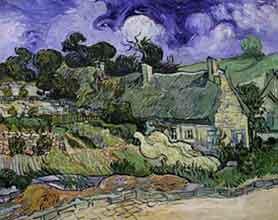
The following day, we went to the Musee d’Orsay together: 19th and early 20th century. There I stood in front of this Van Gogh with tears in my eyes. I marveled at several Monets. Yesterday, we went to Picasso’s house, and I laughed and laughed and laughed; Pablo had such a great way of looking at the world. To him, the world was a big joke, and he shared that joke with all of us.

On a tour of Notre Dame on the weekend, our tour guide—a lovely woman of about 80—argued that Louis XVI didn’t deserve to lose his head, that he was trying to bring in reforms.

No he wasn’t. He was trying to change things just enough to shut people up.

I don’t believe in capital punishment—ever. But I sure understand the anger of the French people in 1794. Louis deserved to be thrown out. He deserved to lose everything. He and Marie Antoinette needed to learn what it was like to have no bread and be told to “eat cake.”

I hate the damn Louvre and I will never return. It makes me sick. The place is an abomination. The art is largely the work of sycophants and phonies.

We can do better. France can do better. Tear the damn thing down. Better yet, break it up into low cost housing units. Do the same with Versailles. I love the thought of some welfare mom from Algeria raising her kids in Marie Antoinette’s bedroom. That will make the Austrian bitch squirm, even down there in hell.

-30-

Friday, October 07, 2005

Week 9 - Winding up Belgium


Sunday, September 25, 2005

As you may recall from last week’s installment, we left Jan, caregiver to the cat athlete, in Oudename and headed for the Brussels area.

On the way, we had to stop for a bike race, the first one I’ve seen since my teens. I heard later it was the Tour de Belgium, but I’ve no idea if my leg was being pulled or not.

Our next host was Luc Hellinckx in Halle, Belgium. Halle is still in the Dutch-speaking part of the country. (We always seemed to be about six kilometers from the language border.

Luc is a math teacher at a local technical school. His wife, Hilde, is not home. She runs some schools for Afghan refugee children in Pakistan. They only get to see each other four times a year, which is a shame given that he is a great guy.

Luc took us out for dinner at a local restaurant. He likes to cook about as much as we do.

Terre's favorite part was the cherry-flavored beer.

Monday, September 26, 2005

We stayed home, rested and caught up on e-mail. A thrilling day.

Tuesday, September 27, 2005

We took the train into Brussels where Terre took the mandatory picture of the little pissing boy. I, on the other hand, fell down and tore my knee open—again. This is the third time I have skinned my left knee on this trip. This time I also tore my jeans. I now have a small, Canadian flag patching it.

On the way home, Terre had to use her French skills to check whether the train we were getting on stopped in Halle. I had tried in English and failed miserablhy. We needed to check because (a) we weren't sure which train we were getting on (b) if we were on the right platform (it was very crowded) and (c) if this one might be an express that skipped our stop. We'd had to rush to catch it—we only had four minutes—and we weren’t sure.

Once on board, we had to carefully watch for the station since we didn't know the order they were in.

Dinner was out choice of frozen entrees. Luc started to apologize but I told him he cooked like we did.

Actually they were much better than the ones we usually have.

Wednesday, September 28, 2005

To Waterloo in the rain. This was a BIG disappointment. It’s a big pile of dirt with a statue of the lion on top. They want a €8.50 to let you climb up the big pile of dirt to the lion. We passed.

There’s really nothing to see unless you want to take a tour and pay even more money. Cornfields. That’s about it. Historic cornfields, I’ll admit, but still just cornfields.

Terre cooked us a gourmet meal that night of her exquisite corn beef and cabbage soup, something new to Luc. She laid such a beautiful table that both Luc and I got out the cameras.

After dinner, I played badminton with Luc and one of his friends for their regular Wednesday night game. I lost. A lot. Badly. There will not be pictures of this humiliation.

Thursday, September 28, 2005

We stayed another day with Luc. We are really enjoying his company and, apparently, he is enjoying ours.

Terre made lunch, this time. Egg salad sandwiches and more of her corn beef and cabbage soup. We took more pictures.

Friday, September 29, 2005

Finally, we were going to have to move on. We hung around Luc’s as long as we could. Neither of us wanted to leave! He didn’t want us to go. But our next hosts were expecting us. Nonetheless, we didn’t go until after 4:00.

Our new hosts were Jo Verwimp and Cecile Sillis, an older couple – probably my age – who have been deeply involved in the Green Party forever, like since it was yellow. Their son, Johnathan, is a law student in Brussels.

They had a great wireless Internet connection. To us, this is important. On a scale of 1-10, it gives a host 12 points. I think Jonathan set it up.

They have been very involved in SERVAS as well for many years. Unfortunately, we didn’t get to really start to get to know them until breakfast of our last morning when the conversation become animated and interesting. But then they had to rush off to a Green Party meeting and we had to move on.

Saturday, September 30, 2005

We visited the Atomium, a building designed to look like an atom. It was put up for the 1958 world’s fair in Brussels. We couldn’t go in, however, as they were working on it.

Saturday, October 1, 2005

We had several more invitations in Belgium, but we decided to move on to France—finally—since it was now October. We headed south towards Amiens and its marvelous cathedral. We camped for the night in a village campground, about 25 kilometres north of Amiens.

Friday, September 30, 2005

Week 8 - Beer, Chocolate, and Remembering

by Tim Perrin

Monday, September 19, 2005


Belgium has turned out to be a delight, but that is primarily due to our marvelous hosts.

After saving us from ourselves, Dirk and Magda were phenomenally generous and fun. Magda had to work too much of the time so we didn’t get to spend as much time with her as we would have liked, but Dirk retired obscenely young and was able to take us to Brugge for the day.

Today, Brugge is about 15 km from the sea, but in the 1500s it was a thriving sea port. However, its sea access silted up and that was that.

Today, it’s a pretty tourist town trading on its medieval heritage.

I have to say that I thought I would be getting tired of medieval towns by now, but I’m not. (Talk to me in another six months.)

Tuesday, September 20, 2005

In Canadian military history, the name Passchendale is one of the most important. The Passchendale action was merely part of the larger battle that took place around the town of Ypres, which had the unfortunate fate to become a place the Germans wanted and the allies decided to defend. In fact, there were three battles for the town. The first occurred in late October and November 1914. In the second, in April and May of 1915, the Germans tried out their new secret weapon, chlorine gas. After this attack failed, the Germans contented themselves with merely blowing the town to bits with constant bombardment.

But it was the third battle of Ypres that has come to be known simply as the battle of Passchendale. Unlike the others, this was launched by the allies. The British commander, General Haig, hoped to break through the German lines, though why he thought he could do so after three years of stalemate is beyond me. Nonetheless, in July, he started a 10-day bombardment of the German positions. So much for surprise. When the troops came out of their trenches, the German machine gunners were ready for them. Over the next three-and-a-half months, more than 310,000 allied troops were killed and wounded, more than 250,000 Germans. In the final push in early November, British and Canadian troops survived mustard gas attacks to take Passchendale ridge, General Haig declared victory, and everyone dug in for the winter. At its greatest, the advance had been about five miles.

More than 12,000 victims of the various battles in and around Ypres are buried at Tyne Cot War Cemetery in Passendale (the modern spelling), about eight kilometers northeast of Ypres. About 1,000 of them are Canadian, more than half of them unidentified. Another 35,000 names of men whose bodies were never found are inscribed on the marble walls of the cemetery. Below one panel, we found a note:

James Smith Graham:

We are sorry that life was taken from you so early and that we never
had the chance to know you.

From your grandchildren,
Hugh, Alison, and Jean.

It reminded me of the notes you see at the Vietnam Memorial in Washington.

The cemetery was built in this location because a first-aid station was set up in a cottage (the Tyne cottage) and they had to bury the bodies nearby. Today, the memorial is built around the cottage. You can still see one of the walls through a gap in the wall of the memorial.
There were several Royal Flying Corps pilots, just 18, lieutenants at that age, shot down over the battlefield.

One of the reasons I go to the cemeteries is to say that I remember and to say “hello” to the guys there. They died a long way from home and I’m sure there are many who have never had a visitor from home. I know they’re dead, but if there is an afterlife, and if they are watching us, I want them to know that even though I disagree with war, I recognize what they did and the sacrifice they made, and how they suffered, and in the long run, the life it bought for me.

(There were also two German buried there. I made sure to tell them hello as I expect they don’t get many visitors in this cemetery full of Brits, Canucks, Aussies and Kiwis.)

It was also at Ypres that Canadian field doctor John McCrae knocked off a few lines of poetry while he was sitting on the bumper of an ambulance. He didn't think much of them and he tossed the piece of paper away. But one of his friends picked it up and sent it to Punchwhich printed it--without a byline--on December 8, 1915. McRae's poem was printed at the bottom of page 468, right after an ad for "The Little Dentist.--Entire outfit, including minature Forceps, Gags, Gasbags, etc. Will keep an entire nursery happy for hours. Help baby with his teething. 5s 6d."

It was called "In Flanders Fields."

Today, in the museum at Ypres, there is a small glass display case devoted to McCrae and his poem. I particularly appreciated the fact that it included a "refutation" from artist Brody Neuenschwander who had tried to prepare a calligraphic interpretation of the poem but who had found himself unable to do so. "It was not difficult to make backgrounds that suggested the grayness of the Flemish skies," he wrote, "and the deeply depressing aspect of the mud and the death of the trenches. But everytime I placed the words of the poem over the background, I read the words, 'Take up our quarrel with the foe,' and I saw that it did not work.

"John McCrae's own handwritten copy of the poem has become an icon of the famous text. We see it, we know what it says, we accept it. But do we stop to ask what the poem actually says? Do we want to know why so many young men were so willing to follow their comrades to the front? Do we have any idea of the social and politcal pressures, propaganda and un-critical patriotic enthusiasm that allowed the leaders of the time to commit this vast slaughter?"

On the way home, my eye was caught by a sign not far from Dirk and Magda’s house that said “452 Sq. RCAF Memorial” and pointed down a little side road. We did a u-turn and turned down this short dead end. On the edge of the lawn of the farmhouse at the end of the road was a marble marker commemorating the crew of an RCAF Halifax that crashed nearby in 1944.

Memories of the war(s) are everywhere in this part of the world.

Wednesday, September 21, 2005

On Wednesday, we finally said goodbye to Dirk and Magda and moved on to the tiny village of Tiegem where our hosts were Jan Glorieux and his orange tabby Leo Russo, the cat-athlete.

As I said in my last post, Jan is one of the neatest guys I have ever met. Bright. Fun. Educated. Loves to discuss anything, including politics and religion. He and I got into some great discussions about Catholicism. He was one of the few people I know who would go head-on with me about the church. I loved it.

Leo loved Terre, meanwhile. She would carry him around while he purred so loud we thought there was an earthquake going on.

Thursday, September 22, 2005

Lazy day. We walked in the countryside then to a park where we came across the chapel of St. Arnold of Tiegem, the local saint. Terre was shocked to see her first relic (other than the one to which she is married). At the front of the church was a glass display case containing the arm bone of St. Arnold. At special times of the year, the devout kiss the display case to show their devotion.

We decided that what we need in North America are local saints, someone from the neighborhood whom we could venerate, whose finger bone we could keep under glass somewhere to take out once a year and kiss, and who could do miracles for us, like give the BC Lions a winning season or help the NDP win another provincial election this century. We are open for nominees.

Friday, September 23, 2005

We went to Jan’s school in Oudenarde in the afternoon as surprise guest teachers for his English class. Terre, of course, was a brilliant teacher, devising a lesson plan as she sat in the staff room. I, of course, winged it.

Jan asked those students who thought they were pretty good in English to hold up their hands. They came with me to another room where, of course, I talked about Canada.

Terre got the other students. She engaged the less confident students by asking them to tell her what she should experience in Belgium. It'a always easier to talk about what you know. (Terre says that why I talk too much - I know too much about everything and don't know how to shut up and let someone else speak.) The students talked about Belgian french fries (French fries were invented in Belgium and should be called Belgian fries), Belgian chocolates, Belgian beer, and the famous Belgian statue of a pissing boy, the Mannequin-Pis, which one of the kids was kind enough to draw for her on the blackboard. The students wanted to move to Canada until they learned that the legal drinking age is 19 in Canada. In Belgium, it is 16. In fact, we ran into many of the students when we stopped off for a drink at an outdoor pub after school in the town square.

It was my birthday* and they bushwacked me with a delicious box of Belgian chocolates and all the kids sang "Happy Birthday" in English. They sang quickly but with big smiles on their faces because the bell had already rung and it was Friday, last period, and they wanted to GO! However, so did we. In fact, we beat them to the pub!

*56 if you must know.

Saturday, September 24, 2005

We started to go on this tour of some abbeys in the region, but all of us, Jan included, copped out after the second one. Sorry, but booooring.

At the first one, the good sisters regaled us with a 50-minute presentation (in Dutch) on the history of their Order. I’m sorry, but I didn’t take notes (It’s hard to do so when you are nodding off) so I can’t really share with you any of the thrilling highlights here. Suffice it so say that a bunch of women decided to live together and be nuns. The End.

At the second stop, we saw the school that the King’s son used to attend. This should have been a warning, because, half an hour later, we were in the cafeteria for lunch. “Oh no, Jan. This one is on us,” I said. The three of us had sliced turkey loaf with gravy, nuked frozen veggies, fries, and a dessert. Total: $54 in Canadian funds (or 36 Euros for cafeteria food!) Ouch! They have got to be kidding.

That evening, Jan and I played dueling keyboard artists. He won. Terre and the cat left the room whenever I started to play.

Sunday, September 25, 2005

Jan insisted on taking us for lunch at a very nice Italian restaurant in Oudenarde. He knew we couldn't afford the high Euro prices to dine out but he really wanted us to experience a good meal in a restaurant before leaving Belgium. Suffice it to say, the food was delicious - much better than the cafeteria—and even more expensive. Thanks, Jan. It was a real treat for us and so very kind and generous of you.

Jan doesn’t like long, drawn-out goodbyes, and neither do we, so we walked back to the car, I shook his hand, Terre gave him a hug, he climbed in his car and drove away. We climbed in ours and were very, very sorry to see him go.

I started her up and headed for our next stop.


Friday, September 23, 2005

Week 7 - Wevelgem Adventure

by Tim Perrin

Yes, I know we've missed week 6. Terre is working on it. Meanwhile, we're finally out of Holland and in Belgium.

We're in another tiny place called Tiegam in Belgium, East Flanders to be more precise. Our current host, Jan Glorieux, teaches English, German, Dutch and religion at a catholic school in a nearby town. He is a 48-year-old bachelor who lives alone in the old family home. He inherited his one-third and bought out his two brothers' interests when his parents died. Basically, he's lived in this house his entire life. He's brilliant, eccentric, and a lot of fun. He'll probably never marry at this point, which is too bad, because I think he'd be a great dad. But I doubt he could adjust to living with someone else, and he is quite conservative religiously so I don't think shacking up is an option. He is a great guy.

Tomorrow, we are going with him to a bunch of abbeys in the area, seven in total.

We are here until Sunday. After that, it's up in the air. We have some emails out to people around Brussells but no takers yet. We do have a spot at the beach for October 3-6 and an offer for the 10th for two nights, but we may have moved on to Paris by then.

Terre wants to get to Giverney and Monet's garden before they close at the end of October. We will spend a week or two around Paris, probably staying on the outskirts and training in, or perhaps leaving the van with a host on the outskirts and then taking just a few things into a host or two in the city. Then we want to head out to the Calais region to visit Dieppe where the Canadians were involved in a disastrous raid early in WWII, then to Normandy, Brittany and south toward Spain, shooting to get there around the beginning of December. We plan on Dec-Jan in Iberia, Feb-Mar across the Riviera to Italy, then Apr-Jun in the UK and Eire. We used to think that was plenty of time, but I don't know anymore. We are now in week eight of 48. It is going real fast.

Before this, we stayed three nights with a couple of PE teachers who just came back from a year of cycling in Cuba, Baja, Australia and a few other places, a total of 20,000 km (12,000 mi). He is 18 months older than I am and retired. She has another 18 months to go to retirement. Then they will ride, ride, ride. They are biking nuts. We loved being with them. Great folks named Dirk and Magda.

They saved us from a bad night. We didn't have a place on Sunday night so we were going to camp. We drove by Antwerp and spotted the gothic cathedral spire but weren't going to stop. We were going to head out to the beach and find a campground, about a 40 minute drive. This was about 5:45.

But Terre seemed to want to see Antwerp, or at least the cathedral. But it took a bit longer than anticipated to enjoy our first genuine Belgian French fries (why aren't they Belgian fries? They were invented here.), see all the guild halls on the city square and get lost in a two block area.

We ended up back at the van in the dark looking first for a campsite, then for a bank machine because we didn't have any cash to pay for the campsite, and doing this in the dark. Our GSP navigator kept sending me to bank machines which would not give me any money but kept wanting me to go to a bigger city.

Finally, I was driving to said, bigger city, when Dirk and Magda called offering us a place.

This however, was just the beginning of the adventure. It was an hour's drive to their place and it was already about 9:00. We programmed in the address, Wagenmakersstraat 2, Wevelegem, and off we went.

Fifty minutes later, we arrived at this rather dodgy looking street right off the main drag where there were a few seedy-looking clubs. There were no apparent homes, just a KIA dealership. Not the kind of place we wanted to leave the van. In fact, Terre at one point didn't want to get out of the van.

And there was no number 2. There was a 2A and a 2B, but not 2. We rang 2A. A gentleman with muttonchops and a handlebar mustache in a uniform answered. Terre, with her suitcase in hand and pillows under her arm asked, "Were you expecting us?" He looked at her puzzled. This definitely isn't Holland where everyone speaks English. In Flanders, the first language is Dutch, but in Belgium, the other language is French so she switched to French and we were able to ascertain that this was definitely not the place.

We called Dirk and Magda. It turned out that there were two Wagenmakersstraats in the region.

Dirk gave me directions. Take the A17. First exit. Past the traffic lights. Church. Cemetary. Left. First right. Second left. Third right. Second left. Piece of cake.

Nope. We ended up on the A19. Shit! Shit! Shit! I was tired. I was grumpy. I wanted to go to bed. It was after 10. I just wanted it to be OVER.

Our navigation system was going to be no help in this case. Our maps were of such a large scale, they didn't even show the tiny town we were looking for. We were on our own.

I decided to take the next off ramp and consult the map to see how to get back to the A17. As we neared the top of the off ramp, Terre spotted the sign for "Wevelgem," our destination. Horseshoes up the ass, or what? So, we turned left and away we went.

Now, we could have been coming in from a completely different direction, but, no, there was the traffice light, church, and cemetary (hard to spot behind a fence and a hedge at night, but hey, we did it), so we start counting lefts and rights.

But then it goes to crap again. We are coming up to where we should be finding that last "second left" and it's not going to happen. Corn field. No left.

I turn on Ken. (That's our navigation system. Ken is its voice. He from Australia. "Turn roit. Take the motorway." You know.) Anyway, Ken has the streets maked on his map so we can see there is no left turn up ahead.

At the risk of repeating myself, shit! Shit! Shit!

But Terre says, "Turn right here. I think we miscounted right turns."

So I do. What the hell, I've got nothing to lose. And lo and behold, there on Ken's lovely face, two blocks up, is Wagenmakerstraat, a tiny cul-de-sac with one entrance.

Double horseshoes up the ass.

How we got there, I'll never know. Someone was guiding us, and for once it wasn't Ken.

That is the first seriously bad steer he's given us. Up to now, it's been a completely reliable system. But, for today, Ken is in the dog house.

That's it for today.

Tim